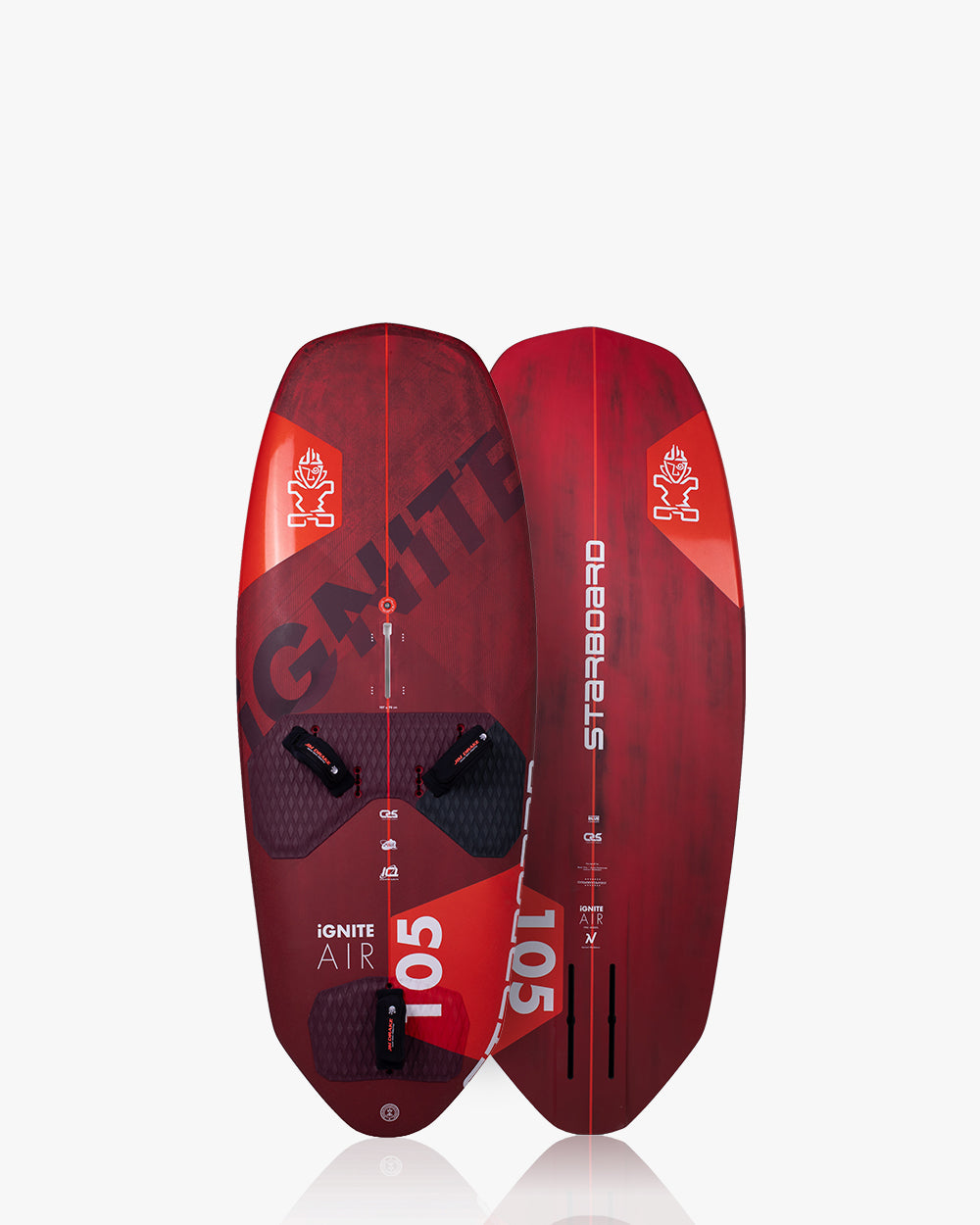
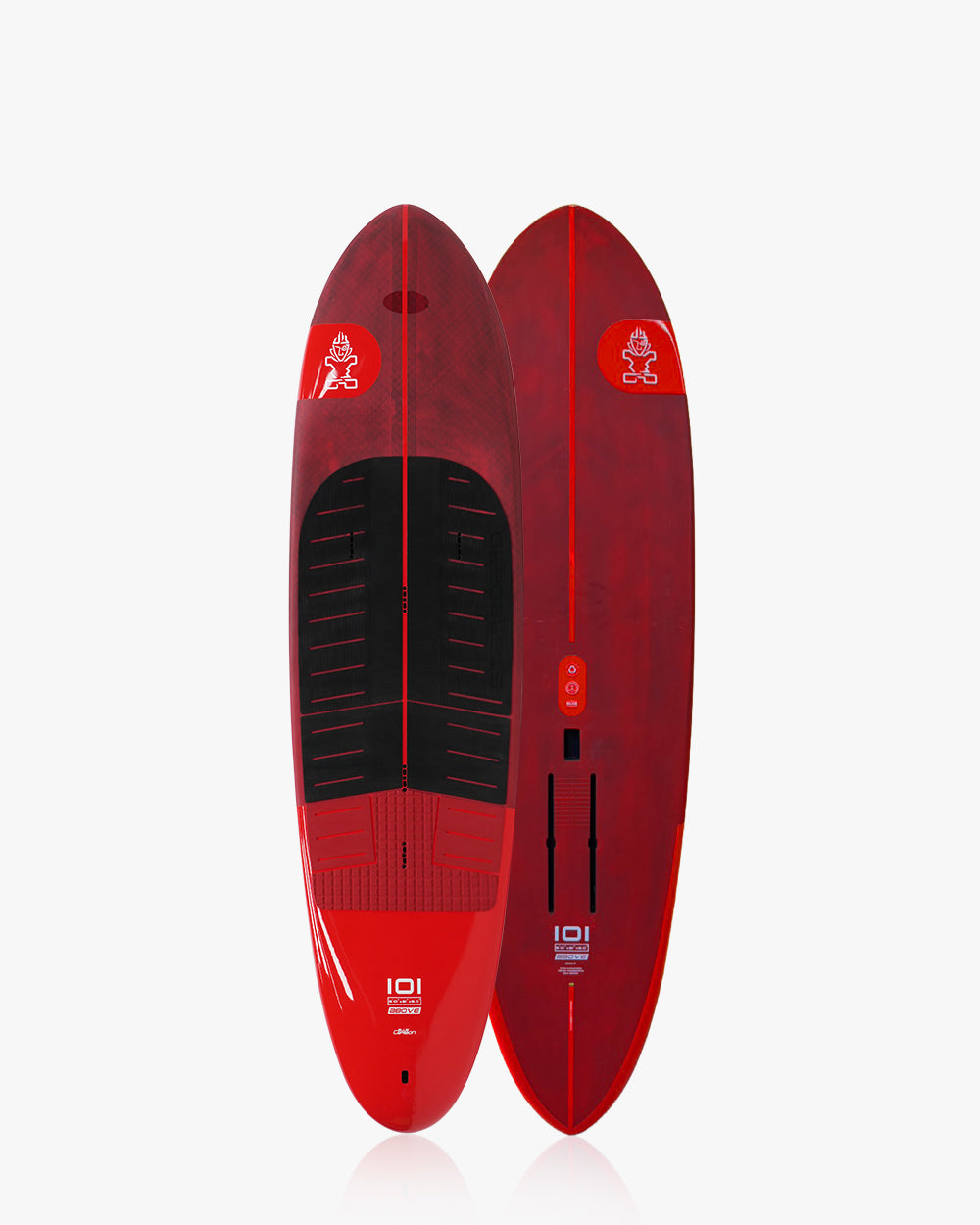
Thinner noses and deeper deck concaves lowers the boards' centre of gravity and shifts it backwards: sharper response, more control and a more natural, neutral balance.
Wood technology construction provides the most dynamic shape stability.
Wider-tail designs for higher planing surface efficiency, more power and more leverage.
Cutaways reduce wetted surface area to provide higher efficiency and improved fin drive
Tail side cuts and wingers for improved water release and fin drive
Double wingers increase width between your feet but reduces width behind: for a more efficient planing surface
2 fins are supplied with the iSonic 101, 111 and 122 to maximize wind range
Inboard and outboard insert settings adapt to various riding styles and feet size iSonic 76, 86, 94: front foot and back foot are adjustable (inboard, outboard, angle) iSonic 101, 111, 122, 133, 144, 150: back foot only
Squared-off nose shape allows for a lower nose rocker: creates a lower aerodynamic and hydrodynamic angle of attack for maximum efficiency
At the start of the 2009 development cycle, Dream Team riders Kevin Pritchard, Julien Quentel and
reigning double World Champion Antoine Albeau sat down with the R&D team to go through a full iSonic
debriefing. The boards are the most advanced slalom boards on the market. They win the tests, win the
races and they are considered the benchmark for the industry. What to do next?
The riders were clear: the iSonics already had the edge on the start line. With their wide tails, they
had the power and upwind capacity to give the rider the edge to gain pole position off the line. For
overtaking, the same power and upwind ability allowed them to capitalize on the board's speed advantage.
As a rider like Antoine proved time and time again, the iSonics allow you to constantly position yourself
in an overtaking position, either to leeward or to windward.
As for control, the trio was unanimous: the slim shapes and low nose rockerlines provided impeccable
control. The square nose effectively increases the boards' average length without physically making
them longer, allowing for a lower nose rocker. A low nose rocker generates less aerodynamic drag, less
lift in the gusts and provides a shallower angle of attack for the water as the board flies over chop.
A key breakthrough in the development of the iSonics since they were first introduced, this low-nose
rocker concept was the start of the maximum efficiency concept.
In the jibes, the iSonics already had the instant response and the fast exit speed with extra power to
gain yet a few more meters. As German Surf magazine puts it: "the board offers all the requirements
needed to win a race and with a great control. Not only that, but at the jibe mark the iSonic 122 can
gain some meters too. It doesn't really matter how rough the conditions are, the board always finds
itself into a stable position on the edge and carves into a self-adjusting turn. It can be pressed into
narrow turns surprisingly well too, where it keeps a lot of speed to give an advantage coming out of
the jibe and into the next reach".
So by the end of the debrief, Kevin, Julien and Antoine's wish list was clear: simply some more speed.
And so the R&D team got to work.
The breakthrough came with the double winger concept. Last season, the iSonics introduced a hipped
outline concept that made for a more efficient planing surface. And from that concept, the double
winger idea was born.
The theory behind the concept: where the water first touches the board, this is where lift is greatest.
Where it leaves the board, this is were lift is minimal yet drag is still strong. So effectively, you
want more width at the leading edge of the planing surfac and less at the trailing edge of the planing
surface. Based on this idea, the concepts of cutaways (Starboard innovation 1999), side cuts (Starboard
innovation 2004) and tail wingers (Starboard innovation 2007) were already born. For 2009, Starboard
introduces double wingers.
More width between your feet and less width in the tail and you have a more efficient planing surface.
Kevin has a preference for conservative, smooth, even lines. He was the most skeptical when the first
prototypes were made, but after weeks of testing in all conditions across all sizes and with various
sails, the extra speed and acceleration the double winger concept created was undeniable.
The result: a new generation of 2009 iSonics - incorporating double wingers from the 86 size and up.
More speed, quicker acceleration and more efficiency.
isonic
Further design evolutions
Deck concaves and thinner noses - with extra deep deck concaves and a slimmer nose, the board's centre
of gravity is lowered and shifted back. This improves control and provides a more neutral, natural balance.
Lighter - with a new PVC grade on the bottom, the iSonics shave some weight while maintaining an
all-wood construction that continues to provide superior dynamic shape stability over its carbon rivals.
Summary:
New double winger concept - more efficient planing surface
New deeper deck concaves and thinner nose - more control and a more neutral, natural balance
Lighter construction with a full wood skin - superior dynamic shape stability
What is dynamic shape stability?
It is the board's ability to maintain its shape while sailing. Flying at high speeds over water, the
board is subject to distortions in all directions: bending, twisting and compression. This distortion
is greatest where you can't see while you're sailing: on the bottom of the board, in the area in front
of the fin box. Shape distortions in that area reduce the efficiency of the planing surface. With full
wood construction and its superior dynamic shape stability, the iSonic's construction is simply more
efficient.
isonic
iSonic 76
iSonic 86
iSonic 94
iSonic 101
iSonic 111
iSonic 122
iSonic 133
iSonic 144
iSonic 150
2009 iSonic Speed Special
Over the past seasons, Starboard has dominated the competitive scene using only production boards.
Formula World Champion, Formula European Champion, PWA Slalom Champion, Raceboard World Champion, PWA
Constructor's Champion, Speed World Champion, PWA Wave Champion, PWA Freestyle Vice-Champion, PWA
Supercross Champion.
More than a question of proving the quality in innovation, competing and winning has been the drive of
the Starboard Dream Team since day one. Speed remains the final frontier.
50 knots and a new Speed Sailing World Record are the next challenge and Starboard has risen to the task.
On March 5th 2007, Dream Team rider Antoine Albeau takes a Starboard-built custom board to break the
record and set a new benchmark in the world of wind-powered sports.
For 2009, Starboard is proud to introduce a collection of three new iSonic Speed Specials, exact replicas
of the boards Antoine used to take home the World Speed Champion title. Designed by Christophe Fiorentini
and Antoine Albeau, these three speed boards are simply the fastest production boards in the World.
Christophe Fiorentini: "I have been working actively on the shape of these 3 speed boards since 2005. In
the course of events I have improved the design of each of these boards. To define the ideal
characteristics, we tested boards in the South of France (a spot with very irregular winds and with both
flat and choppy water conditions) but also in Fuerteventura (150? angle with light wind) and in Namibia
(square conditions with 100? angle). Under your feet, the boards accelerate with a great feeling of ease.
The boards have a neutral trim so that wind lulls and gusts can be coped with effortlessly and with
maximum efficiency. The great special feature of these boards is that they keep the speed generated by a
gust of wind for a very long time. The double concave is tailored individually on each model to blend
acceleration on flat water and comfort. See the next page for our recommendation for what fins and sails
to choose."
Summary:
iSonic Speed Specials: the World's fastest production boards
Three models: W44, W49 and W53
Designed by Christophe Fiorentini and Antoine Albeau
Specifications
Model
Volume (litres)
Length (cm.)
Width (cm.)
Tail Width (cm.)
Weight Wood (kg.)
Sail range (Msq)
Fin
Fin range (cm)
Fin box
iSonic 76
76
242
55.0
37.4
6.12
4.5-6.5
Drake Slalom Pro 320
26-36
Tuttle
iSonic 86
86
243
56.5
37.3
5.95
5.0-7.0
Drake Slalom Pro 340
26-38
Tuttle
iSonic 94
94
243
59.0
40.5
6.13
5.2-7.8
Drake Slalom Pro 340
28-40
Tuttle
iSonic 101
101
234
63.5
45.4
6.22
5.5-8.5
Drake Slalom Pro 360 + Drake Slalom Pro 420
30-44
Tuttle
iSonic 111
111
234
68.5
49.9
6.65
5.8-9.0
Drake Slalom Pro 380 + Drake Slalom Pro 440
32-48
Tuttle
iSonic 122
122
231
75.0
52.8
6.85
6.0-9.5
Drake Slalom Pro 400 + Drake Slalom Pro 460
34-50
Deep Tuttle
iSonic 133
133
223
85.0
57.0
7.44
6.5-10.5
Drake Slalom R13 Race NR 520
40-56
Deep Tuttle
iSonic 144
144
225
85.0
57.2
7.69
7.0-11.0
Drake Slalom R13 Race NR 520
40-56
Deep Tuttle
iSonic 150
150
228
93.5
65.1
8.50
7.5-11.5
Drake Slalom R13 Race NR 560
52-62
Deep Tuttle
iSonicSpeed Special W44
53
229
44
26.8
4.72
4.0-6.5
Drake Slalom Pro 240
20-26
Tuttle
iSonicSpeed Special W49
64
230
49
28.7
4.90
5.0-6.8
Drake Slalom Pro 260
22-28
Tuttle
iSonicSpeed Special W53
74
231
53
32.9
5.28
5.5-7.5
Drake Slalom Pro 300
26-32
Tuttle
Wood weights +-5%. Sail ranges and fin are recommended indications.
Starboard windsurfing equipment's technology has proven to win more championships than ever. The innovation and quality gear developed will take your sailing to a new level when you encounter the wind and waves any place any time.