Hi Joe,
I do not think I ever suggested moving the mast foot back ON A SHORTBOARD in higher winds to plane better.
You can keep moving the mast foot back (this diminishes the wetted area of the board as the nose does ride slightly higher) until your board tailwalks out of control.
Solution: move the mast foot back forward to the "sweet spot" for that particular board. This can vary with what "angles" you are sailing.
For back and forth reaching (not at extreme angles either upwind or downwind) every board has a "sweet spot" for the mast foot and a particular sailor/rig combination where it planes effortlessly, at max. speed with manageable control.
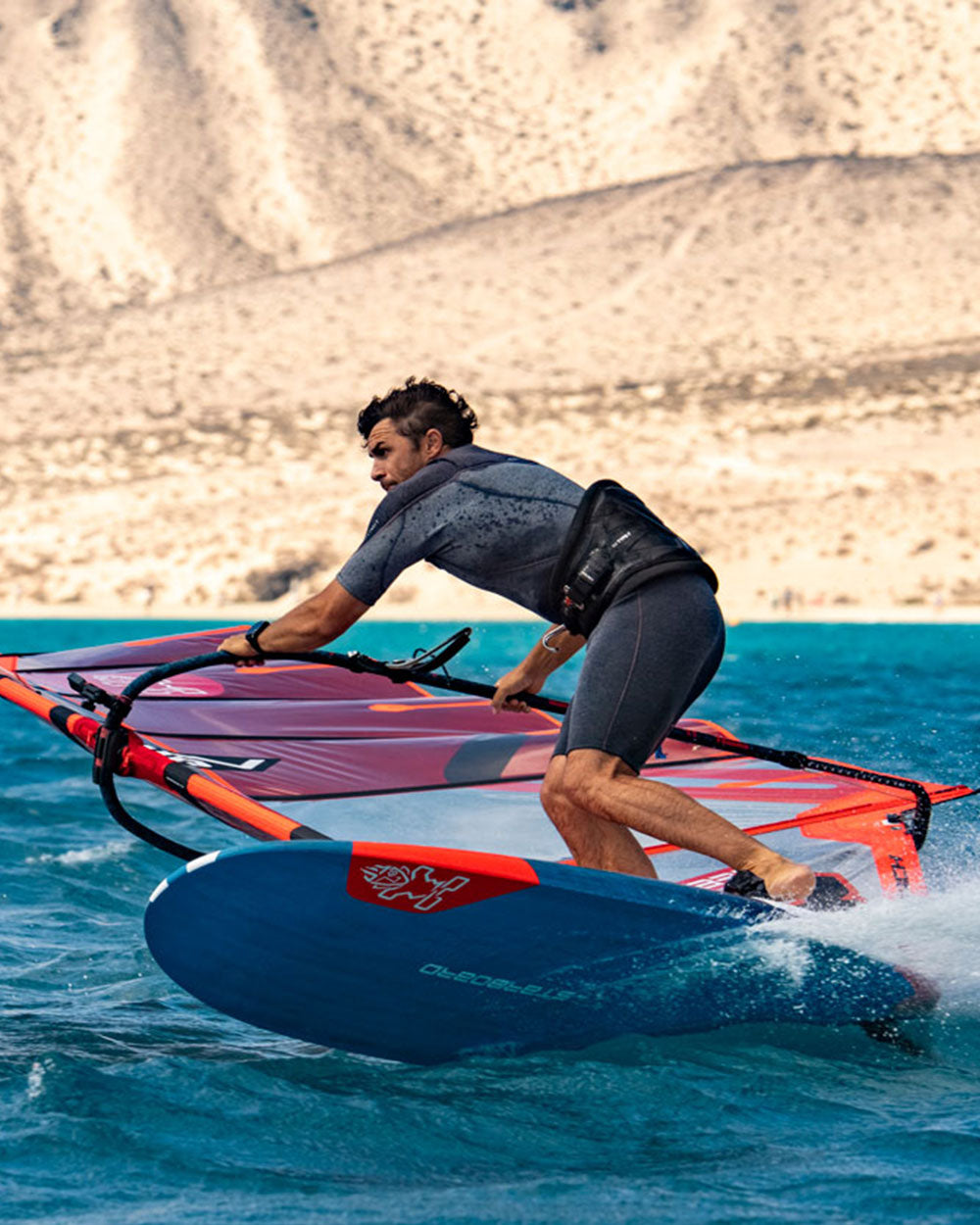
Moving the mast foot forward on a slalom board can slow you down, make the board "pound" over the chop. On the other hand if you move the mast foot pressure too far back you will be out of control.
Out of control/tailwalking may seem fast, but it's not.
Formula boards are very different.
They run the mast foot very far forward (when racing) to be able to run the extremely high and low angles.
When formula sailors are going downwind, they are all the way back and often in the chicken strap in the middle of the board so the sailor weight is at or behind the stern of the board. They dump the outhaul to bag the sail for max. control and speed while standing at the extreme back of the board so they can go nearly straight downwind on a full plane (i.e. they are sailing faster, straight downwind, than the wind speed, so the only wind they have is apparent since they are sailing faster than the true wind.
When going upwind on a formula board the sail is outhauled for max. upwind angle, the harness lines are adjusted very short, and the sailors weight is significantly further forward on the board so they can use their upwind speed to generate more apparent wind to sail higher and faster.
They also tip the board slightly lee rail down and push on their big efficient 70 cm fins to get more upwind drive.
I fully understand the differences between marginal (underpowered planing) conditions vs powered up conditions for a shortboard,a formula board, and a longboard.
All are different, and require different trimming of the boards attitude.
Hope this clears up why you need to alter your trim for different conditions.
Roger
Last edited by Roger; 27th November 2011 at 09:15 AM.
|