|
|
#21 |
|
STARBOARD
Join Date: Aug 2006
Posts: 532
|
And as most of the informed writers in this discussion know,
we actually built and head-to-head tested a lot of 2009 proto full carbon /carbon hybrid iSonics... And guess what?? We really wanted to know if there was a performance edge we could deliver.. And guess what ?? And when a carbon/carbon hybrid (etc) iSonic can outperform current versions, guess what?? Call it what you like... I'd call it logic. Not much guess work. Cheers ~ Ian |
|
|
|
|
|
#22 | |
|
Member
Join Date: Oct 2006
Posts: 248
|
Quote:
The only independent test I have seen on boards weights (UK boards magazine July) shows that, as expected, weight makes no difference for recreational sailors ESPECIALLY in small boards (sub-85/90). It is easy for everybody to test this: just put 1Kg to the mast box of your board and check the non-existent difference in performance. Water floats guys and girls and gravitational de-acelleration is not a function of weight (for the jumpers out there)
Last edited by davide; 19th August 2008 at 02:07 PM. |
|
|
|
|
|
|
#23 |
|
TEAM
Join Date: Aug 2006
Posts: 1,191
|
Yeah, water floats and gravity is gravity. But in the end there is the physics on one hand and the performance on the other hand. I never wrote there will be a distinct advantage for recreational sailors, but from a physics point of view it is easy. Everything else equal a lighter board will easier to move around. A quick cutback is a very fast rotational move as far as the board is concerned. If the board is 20% lighter, you will need 20% less energy to make this move. And if you really put a good experimental physicist on it, of course you could measure it in practice too. I'm the first to say weight is not THAT important in a wave board, but when you sail the same shape in two different constructions you will feel a certain difference after all. But the beauty of it is that any customer has the choice. Nobody is forced to buy a more expensive carbon board. Wood and technora works great.
In slalom, a lighter board would be theoretically better because the board is continuously accelerated up and down by the chop this soaks energy from the forward motion. But this is theory and in practice things like comfort plays a huge role and if test show a carbon board is not faster, then theory will not matter. Even in moto racing the suspension is not tuned for maximum power transfer but for a compromise of power transfer and control/comfort. |
|
|
|
|
|
#24 |
|
Member
Join Date: Aug 2006
Posts: 327
|
Just a very very very little tiny bit...
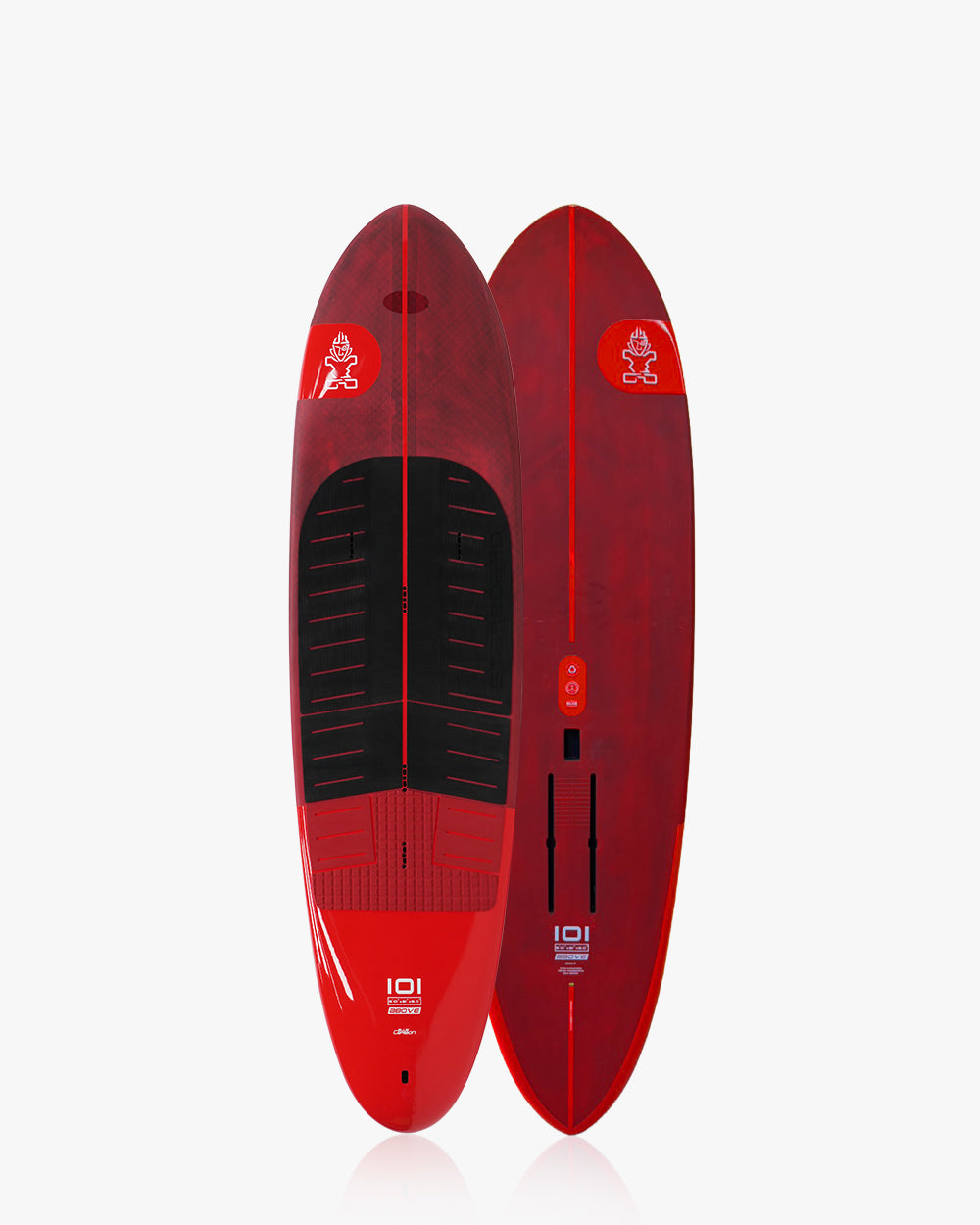
By the way, phisics is phisics. For some mysterious reason, my personal experience agrees 100% with phisics, Starboard test team's does not. Over time I used quite a few medium wind slalom boards of about 100 lts. volume; and lighter meant nicer to use (I am a recreational sailor with a taste for speed, so nice to use means a good deal to me), always but in one single case where I went too far (5.3 kg, Nomex construction). Light weight means low inertia and the boards' ability to follow the water surface with less sticking in and (unwanted) taking off. In my view and experience this is an advantage until one is able to rule and tame the board's ride. A pro rider, plenty heavy strong and fit, will love light weight to a much farther extent than a recreational sailor, whose legs and ankles will be fatigued pretty soon and loose the ability to keep the board on track. So for recreational sailors "lighter is better" is not 100% true, but rather there is an "optimum" point of balance. That point, in my view, for medium wind slalom boards of about 100 lts. (what I ride) falls somewhere between 5.5 and 6.0 kg, which is lower than Starboard's offerings (iS94 and iS101) in that class, even not considering the +/-6% tolerance that in my experience hopelessly reads "+" for people buying their kit in shop. Well one could say 6.2 is not that far from 6.0; but 6.2 + some% is very far from 5.5! For this reason, I thought the intoduction of carbon wood versions was the occasion for Starboard to introduce lighter slalom boards; and for this reasons those "corporate" answers "trust me, I tested it and despite everything this is what we found" sound fake to me. Maybe I am wrong but, honestly, this all drives me another step back from entering that shop and order an iSonic. Was I able to sort a really "-6%" sample from the production lot, it could be different. By the way. Ola: there is no way vertical accelleration induced by chop may soak energy from forward motion: the directions of that accelleration and that motion are 90° from each other. It is true that extra weight will make the board react slower because of inertia, so there will be more "sticking in" before lift will free the hull from a piece of chop, and more "air time" from any piece of chop before one is able to push the board down and apply drive again. Last edited by geo; 19th August 2008 at 01:16 PM. |
|
|
|
|
|
#25 | |
|
Member
Join Date: Oct 2006
Posts: 248
|
Quote:
* If the board is 20% lighter (which cannot be, you cannot gain 1Kg out of a 80L sandwich board just because you use 4oz Carbon instead of 4-6oz fiberglass) you still get at most a 1% difference in TOTAL weight (board + rig + sailor). (Won't even enter a discussion about rotional weight, because then you realize that the supposed 20% weight difference is distributed over the length of the board and most of it has no influence whatsever in quick changes of direction). * Water floats indeed: and any weight difference is cut at least in half because you are ... sailing on water ... not dragging your rig on mother earth. * you say "comfort plays a huge role" in slalom but apparently this reverses in B&J and Wave? Do we have to conclude that Starboard "tests" demonstrate that a carbon construction is not as fast and less comfortable in a slalom board but actually is faster and more comfortable in a Wave board ....? * By the way any discussion about carbon vs glass vs aramid is quite nonsensical. What matters in a sandwich construction is the core, and the fibers, and the # of layers, and the orientations used ( and the resin and and curing too). You can easily build a carbon board that is flexier then a glass board. Just discuss fibers is useless. Some examples of constructions? *** I ride Carbon Art boards that happen to be the most comfortable slalom boards I ever rode: I wonder how they manage to do that since they are 100% carbon. *** AS far as I know, Mike's Lab builds everything in carbon but NOT the small sizes, where S-glass is the choice, for slalom too, because Carbon is simply an overkill in his opinion ... Last edited by davide; 19th August 2008 at 02:04 PM. |
|
|
|
|
|
|
#26 |
|
TEAM
Join Date: Aug 2006
Posts: 1,191
|
Davide:
When I say carbon (or woodcarbon) in this case, I'm talking of the construction as a whole relative to the wood or technora construction. I agree the fiber per se is not interesting. But there is a difference in both feel and weight in between the respective constructions. Throw in the proto hollow boards that were experimented with a few years ago you have something different again (and here the you can really start to talk about flex characteristics). Interestingly, when you look at the pros that use custom wave boards, they might even have their personal favourite construction. Some (most) like a bit of give but some (like Polakow) like a stiff double vacuumed all carbon construction. As for the physics: 20% is maybe an overestimation, but if you look at the EVOs wood is somewhere around 12-15% heavier than woodcarbon. And if we're talking percentages and assume the weigh difference is evenly distributed, the increase in inertia will in fact be by the same percentage. And in real life more of the weight loss is in the (more important) front part of the board so you will get a bigger effect than this. And the whole point (which I tried to make with bikes earlier) is that you cant add all weights together and expect that to be the end of the story. Again, in a cutback, the board is doing a super quick rotation while the rider moves only very little and much slower. When doing such a move, you will notice more (15%) weight. But is it important in the big picture? Is it worth the extra money? Maybe for some. Maybe for some more if you factor in the psychological feel good associated with a light board. Maybe not for most. That's why there is still the tried and true wood construction. Geo: Yes, that is a better formulation of what I meant. The board is kind of suspending the rider form the chop, effectively meaning you push less energy into the chop. Kind of similar to MX or MTB, in a way. A interesting question if you choose to believe in the proto iS tests (wood as fast as woodcarbon) is WHY this is so? You refer to the riders being super strong and sailing super powered up. But maybe some of the explanation also comes from the shapes. I'm not a slalom expert, but what strikes when riding for example the iS101 is that it hits chop in a surprisingly smooth way, maybe because of the rather flat scoop line and the rest of the nose shape. I very seldom get that feeling of smacking into something on the iSonics, they seem to fly over most and take the rest of the hits very gracefully. Maybe this is what makes board weight a less important factor? |
|
|
|
|
|
#27 |
|
Member
Join Date: Aug 2006
Posts: 327
|
Ola,
I was referring to pro riders, I don't know if all of Starboard's testers are so or else. From the measurements done by PlancheMag it seems the slalom board I am riding now has an even flatter scoop line than iSonic101, in its '08 version at least. I know very well that sensation of flying smoothly over chop, never smacking into it. Nevertheless, I believe much of the crispness of that board's ride comes from its ability to comply with water surface and quickly follow my feet's orders. Heavier, would be different; and not for better in my view. Plus, of course, given any board still has to react to chop in order not to smack into it, my reasoning still applies to iSonics. Thinking better, I would be curious to see how a really light iSonic would be like, given its super smooth ride would probably take away most of the problems common mortals have to face when riding super light slalom boards. |
|
|
|
|
|
#28 | |||
|
Member
Join Date: Oct 2006
Posts: 248
|
Quote:
Quote:
Quote:
Last edited by davide; 19th August 2008 at 09:58 PM. |
|||
|
|
|
|
|
#29 |
|
TEAM
Join Date: Aug 2006
Posts: 1,191
|
Davide, check the weights on the product page. They are based on averages from real production. And the difference is not just a fiber layer change, the whole layup is different, hence the 12-15% difference (on EVOs, haven't checked other boards).
I have to go and dig out one of the hollow boards. They had the vent screw in the nose so maybe you could have someone fill the nose up with half a pound of clay. Or not. Then go ride and try to guess which is it. |
|
|
|
|
|
#30 |
|
Member
Join Date: Aug 2006
Posts: 639
|
Seemingly, the questions that I raised in my post #13 maybe can't be answered directly. Maybe the details are proprietary in nature, so they can't be discussed in a specific way. Still though, under all the paint and attractive appearances, one wonders what's really inside. I guess the +/- 5 to 6% weight fluctuations possible in the product adds even more mystery to ponder.
|
|
|
|
![]() |
| Bookmarks |
| Tags |
| None |
| Thread Tools | |
| Display Modes | |
|
|